

Let's Go Beyond "Earth Day Lite"
Overshoot Emergency Demands Our Full Attention

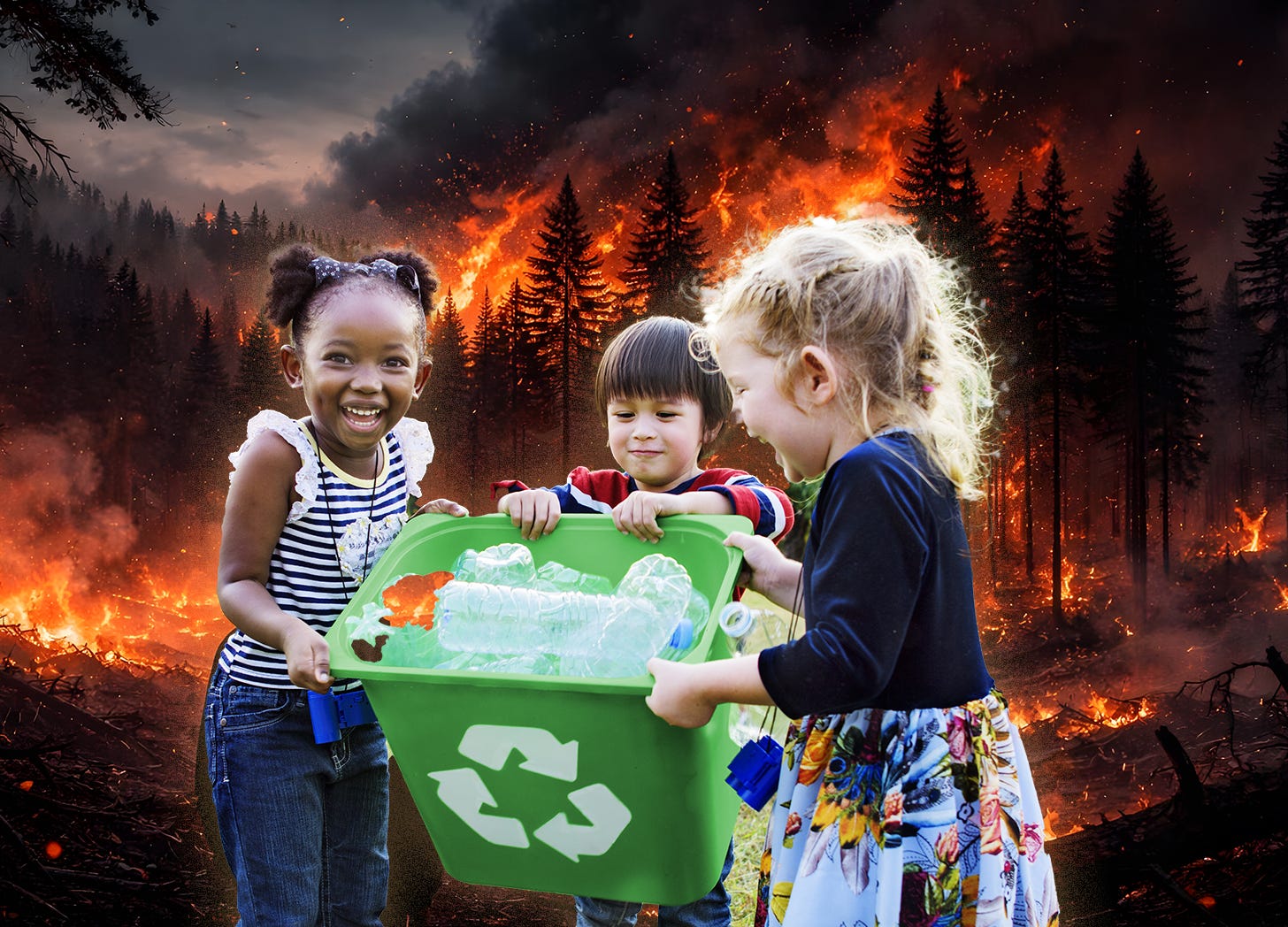
Today is Earth Day. What does that mean to you? When first observed in 1970, it represented a serious wake-up call. It was a response to the news in Rachel Carson’s Silent Spring that the pesticides we were spraying were killing more than just mosquitos. It was a response to the news in Paul and Anne Ehrlich’s The Population Bomb that we were outgrowing our planet. It was a response to the Cuyahoga River in Cleveland, so polluted it was bursting into flames. And it was a response to over four million gallons of oil spilled by a platform off the coast of Santa Barbara.
Everyone was inspired and activated - elected leaders, activists, scientists, teachers and students, moms and dads. In many ways we cleaned up our act. The early 1970s saw establishment of the EPA, the Clean Water Act and the Endangered Species Act. Republican and Democratic lawmakers passed legislation and a Republican president signed it.
But soon, big businesses that valued profits over a healthy planet launched a long-term plan to minimize regulation (see The Powell Memo). They eventually hijacked the White House. In 1981, Ronald Reagan took office, ripped solar panels off the White House, and halted progress on sound environmental stewardship. Over time many of us became complacent. Earth Day morphed into “Earth Day Lite.” For one day of the year, schools would promote recycling to the kids and groups would organize community clean-ups. As I said in this promo video, these efforts are “all well and good,” but they pale in comparison to the task at hand.
What is the task at hand? Scaling back our presence on the planet. We are deep into overshoot and need to shrink both our economy and our population back to a size that doesn’t chisel away Earth’s critical life-supporting ecosystems. Recycling and picking up trash alone won’t do it. If this is news to you, then I strongly recommend you view some of the important films in the GrowthBusters Earth Day Film Festival. If you’re already familiar with ecological overshoot and limits to growth, then gather friends and family for a viewing and conversation. We need to spread overshoot literacy.
I listed No Impact Man as the first film because it really is a great story and one of the most charming documentaries I’ve seen. Also first because it focuses on living more lightly on the planet. I want to be sure that doesn’t get lost among the many messages about overpopulation in the films we’ve curated. It IS critical that every young adult making family-size decisions understands that we have overpopulated the planet. But when your civilization is demanding nearly twice the ecosystem services Earth can provide, we can’t afford to focus on only one of the multipliers in the human impact equation.
Greenwashed, a fairly new film, offers the most comprehensive view of our overshoot predicament. It should be part of life’s operating manual. So pop some popcorn and hold a screening in your family room.
Don’t worry, these films don’t go away at midnight tonight. You can continue this Earth Day Film Festival the rest of the week and into the weekend. And should you see every one of these films, I have a bonus for you. Here are a few films that are every bit as good and important as those that made our festival list:
The Great Simplification | Film on Energy, Environment, and Our Future
An Introduction to the Importance of Oil to Society – 3-part series by Nate Hagens
What Would Jesus Buy?
And here are some great films we didn’t list because they are not available free on YouTube. They are worth the price to rent or purchase:
I Am (available on Netflix)
Visit earthdayfilmfestival.com for a list of the films and links to view them. Or head straight to the GrowthBusters Earth Day Film Festival playlist on YouTube.
#
Dave Gardner is founder and executive director of GrowthBusters.
Support GrowthBusters with your charitable contributions
Follow the GrowthBusters podcast
Follow @growthbusting on Instagram
Subscribe to GrowthBusters email updates
GrowthBusters is a 501(c)3 nonprofit project. Your donations make it possible. You can donate to the project here. I’ve also now enabled paid subscriptions here on Substack.
My posts here will still be available free, but I plan to offer paid subscribers access to some special events. So feel free to upgrade here on Substack if/when you’re inspired.